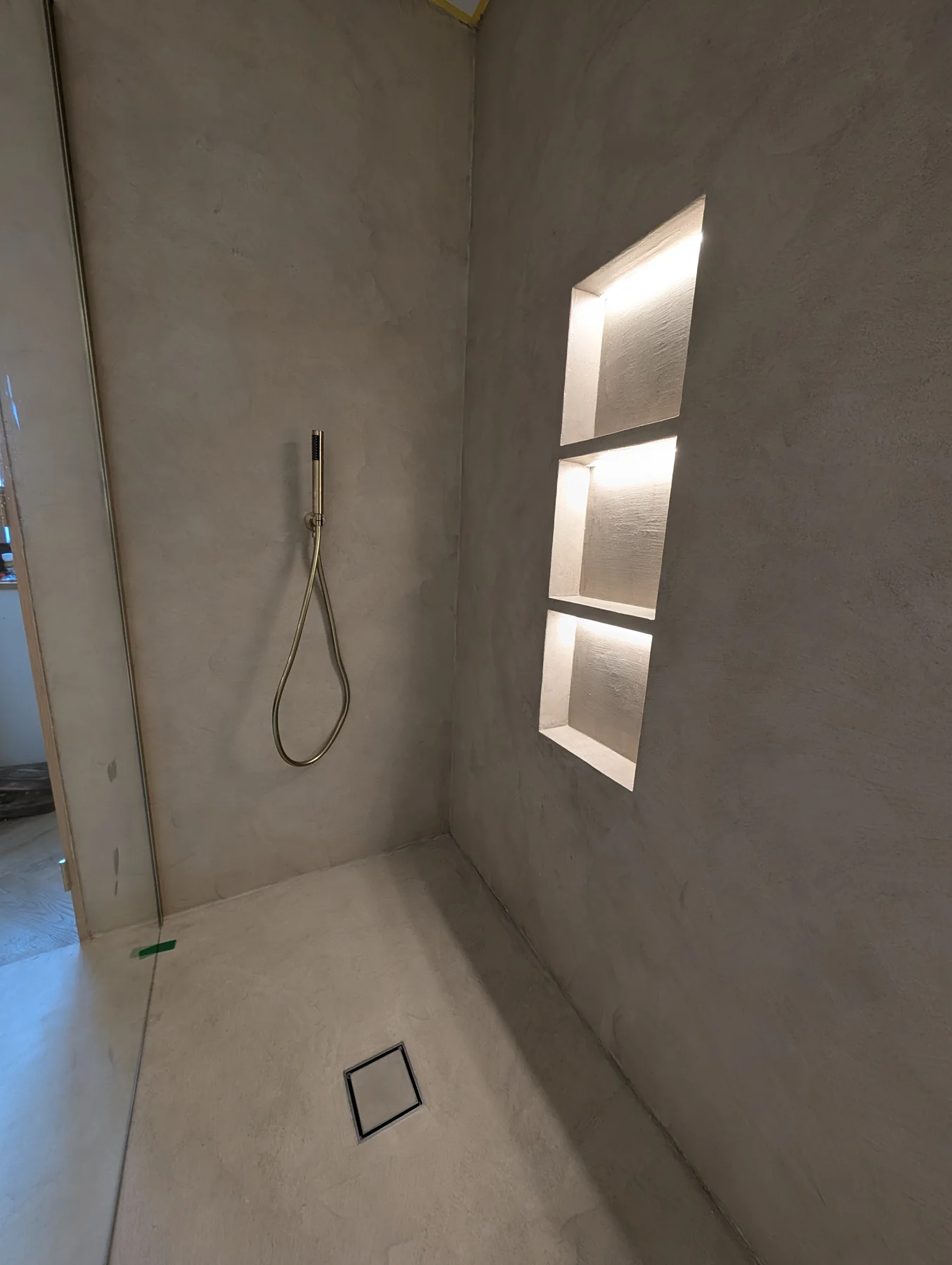
Seamless surfaces / applied by hand
What is microcement?
A thin, layered finish that can turn properly prepared walls and floors into one continuous surface.
I use microcement to create bathrooms that feel calm, tactile and individual. It can be quiet and almost uniform or deliberately expressive—the finish is shaped by colour, product texture and the movement of the trowel.
Why people choose it
Less interruption.
More atmosphere.
-
01
No grout grid
Walls and floors can read as a continuous surface, without conventional grout lines breaking up the room or creating extra joints to maintain.
-
02
Character by hand
Every application is individual. Fine trowel movement remains visible and tactile, even when the chosen finish is restrained and close to a single colour.
-
03
One calmer room
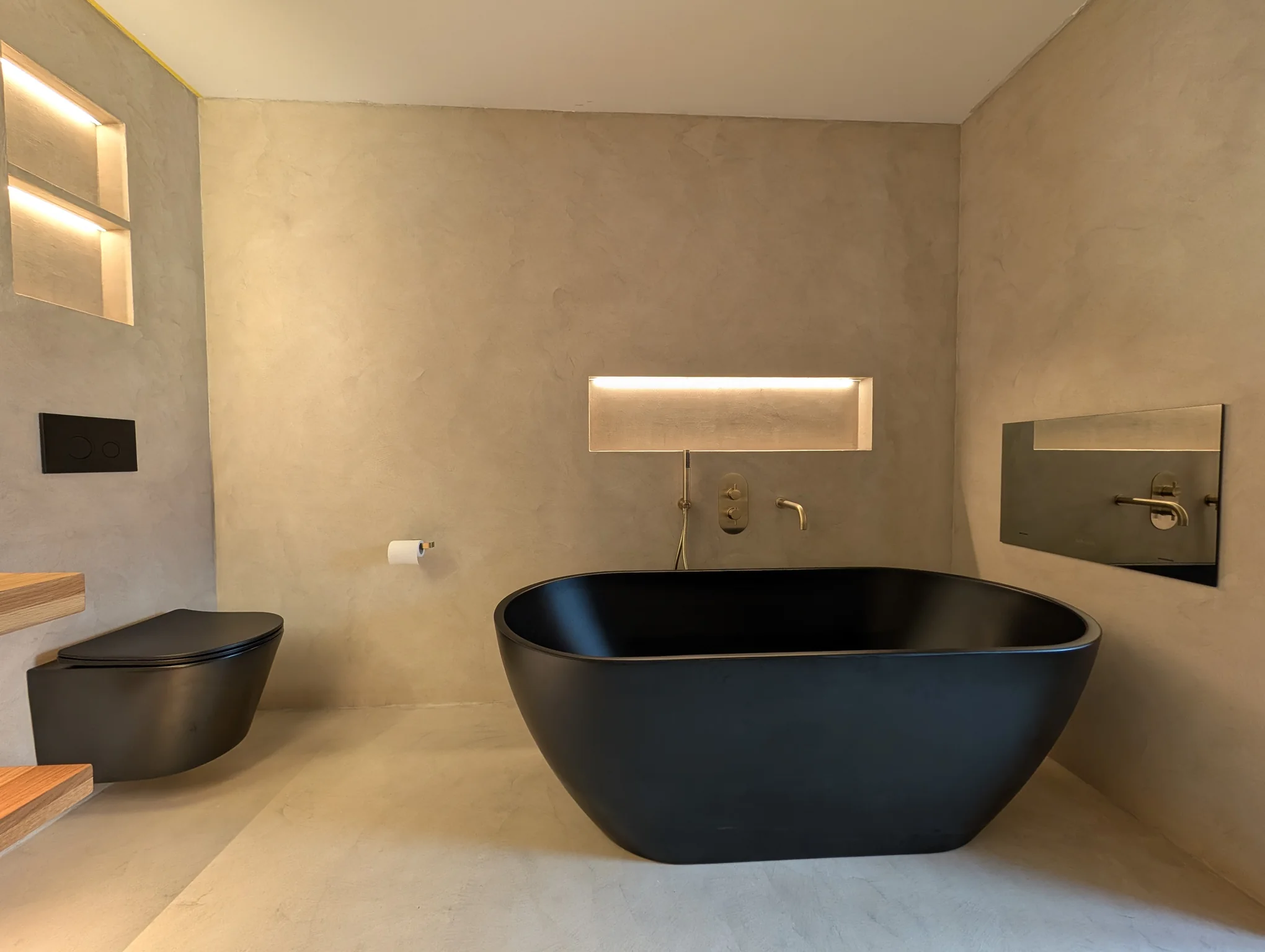
Used across walls and floors, it reduces visual noise and gives the bath, brassware, lighting and carefully chosen details more space to stand out.
Where it works
Far beyond one feature wall.
With the correct system and preparation, microcement can be used across bathroom walls, floors and shower areas. It can also transform feature walls, furniture and worktops, with selected systems available for exterior surfaces.
It may be possible to apply it over existing tiles when everything underneath is sound. I do not treat that as the automatic option: sometimes rebuilding the surface is the right way to create a base worth finishing.
- Bathrooms
- Walls + floors + showers
- Beyond
- Feature walls + furniture + worktops
- Finish
- Quiet + textured + expressive
What sits underneath
The finish is only as good as its base.
Microcement is not a way to hide movement, loose tiles or poor preparation. The substrate needs to be stable, consolidated and properly detailed so joints and weaknesses do not transfer through the finished surface.
That is why I prefer to control—or work closely with—the preparation rather than arrive only for the final decorative coats.
Built in layers
Not paint.
Not a shortcut.
- 01Prepare
Correct and stabilise the substrate, treat joints, then introduce the appropriate primer and reinforcing mesh.
- 02Build
Apply the base and finish coats by hand, allowing the required drying time and refining the texture between stages.
- 03Protect
Complete the specified sealing system to protect the colour and surface from staining and everyday wear. The application itself normally takes at least six working days, separate from wider bathroom preparation.
Honest specification
Possible does not always mean appropriate.
I would not recommend microcement inside a bath or basin that continually holds water. Those surfaces need an exceptionally smooth, purpose-made finish, and glass-fibre-reinforced concrete would be a more suitable route for a genuinely bespoke piece.
The same judgement applies everywhere else: the product, texture, protection and substrate should be chosen for the surface and the way it will actually be used.
Microcement FAQs
The useful questions.
Answered honestly.
Is microcement waterproof?
The bathroom system I use is built up in waterproof layers and completed with protective sealers. It still needs to be specified and installed as a complete system, with the substrate, junctions and wet-area detailing treated properly.
Can it be used in a shower?
Yes. Correctly specified microcement can be used on shower walls and floors. Preparation, drainage, movement control and sealing all need to be considered before the decorative finish begins.
Can microcement go over existing tiles?
Sometimes. The tiles and everything supporting them must be sound, stable and properly prepared. For a complete bathroom, I may recommend rebuilding the surface instead of relying on an unknown base.
Will it crack?
A properly installed system is designed to tolerate normal stresses, but no thin finish can correct structural movement underneath it. A stable substrate, reinforced preparation and correctly treated joints are the best protection against cracking.
Is every finish the same?
No. Microcement is applied by hand, so each installation has its own character. Technique and product choice can minimise the tonal movement or make it much more expressive. Sample boards help us agree the direction before the room is finished.
Can I choose the colour and texture?
Yes. There is a wide choice of colours and different grades of texture. The same colour can also feel different depending on the trowel technique, amount of movement and final sheen.
Does it scratch or stain?
It is a durable surface, but it is not impossible to damage. Sharp or abrasive objects can scratch it and spills should not be left sitting on the finish. Correct sealing provides important protection against everyday staining and wear.
How do I clean it?
Use a soft cloth or mop with a gentle, pH-neutral cleaner. Avoid abrasive pads, steam cleaners and harsh chemicals that could damage the protective surface. Clean spills promptly rather than allowing them to dry in place.
Is it more expensive than tiles?
It is a premium, multi-layered finish applied by hand, so it will usually cost more than straightforward standard tiling. The comparison is closer when set against premium tiles with carefully aligned layouts, mitred corners and detailed niches.
How long does it take?
Once the substrate is ready, the microcement application normally takes at least six working days because each layer needs the correct preparation and drying time. Rebuilding or preparing the bathroom comes before that and is priced and scheduled separately.
Teesside / Whitby / York
Could microcement suit your room?
Tell me where you would like to use it, what surface is there now and whether you are considering a specialist finish or a complete bathroom.